
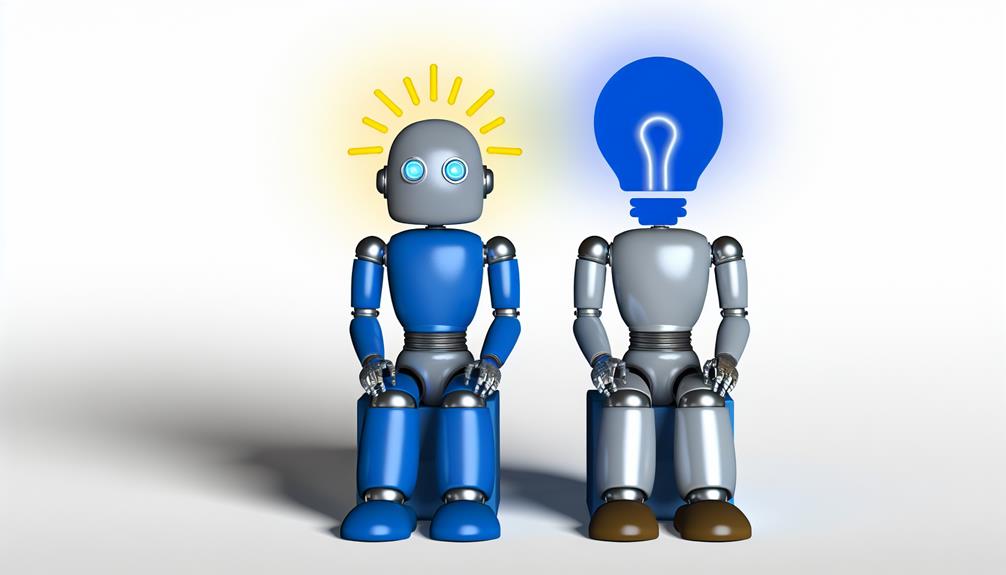
Did you know that Siri is often classified as a Weak AI due to its limited abilities and lack of self-awareness?
But have you ever thought about where we draw the line between Weak and Strong AI?
By delving into Siri's set functions and boundaries in comparison to the potential of Strong AI, we can gain insight into the current state of artificial intelligence.
The distinction between these two categories carries significant weight for the future of tech and human-machine interactions.
It's fascinating to explore how Siri's capabilities stack up against the possibilities of more advanced AI systems.
Key Takeaways
Siri falls into the category of Weak AI, meaning it has limitations and doesn't possess self-awareness. This type of AI, like Siri, operates based on preset commands and lacks the ability for deep learning. In contrast, Strong AI, which Siri is not, exhibits self-awareness and advanced decision-making capabilities akin to human cognition. Strong AI can handle intricate problems effectively, unlike Siri, which aligns more with the traits of Weak AI.
Defining Weak AI
Understanding Weak AI is all about recognizing its limitations and how it works within set boundaries. Weak AI, like Siri, is built for specific tasks and operates within a narrow scope. These AI systems follow pre-set commands to assist users, but they don't have the capability for deep learning or self-awareness.
Unlike Strong AI, Weak AI, such as Siri, lacks human-like understanding or problem-solving skills. Instead, it sticks to predefined functions, giving responses based on its programmed algorithms. The main aim of Weak AI is to efficiently perform well-defined tasks without simulating human thought processes.
Defining Strong AI
Imagine creating machines that think and learn just like humans. Strong AI aims to achieve this by developing intelligent machines with self-awareness, problem-solving abilities, and the capacity to plan ahead. The goal is to design machines that can match human intelligence levels, as envisioned by experts like Marvin Minsky. The success of Strong AI is gauged by factors such as intelligence, comprehension, and problem-solving skills.
These advanced machines can adapt to new situations, make plans for the future, and apply knowledge broadly, much like we do. The ultimate ambition of Strong AI is to attain a comprehensive intellect that enables machines to tackle any challenge presented to them. This all-encompassing intellect would empower AI to operate at a level akin to human thinking, showcasing a wide array of cognitive capabilities.
Essentially, Strong AI strives to create machines that not only imitate human intelligence but also possess the ability for independent thinking and decision-making.
Siri's Classification as Weak AI
Siri falls into the category of Weak AI because of its limited capabilities and narrow focus on specific tasks. Unlike Strong AI, which aims to mimic human cognitive functions comprehensively, Weak AI like Siri operates within set boundaries and can only perform predefined tasks.
Siri generates responses using preset algorithms and data, lacking the ability to think beyond its programmed limits. This classification is evident in how Siri relies on human input for accuracy and can't learn or problem-solve autonomously outside its designated tasks.
Examples like Siri emphasize task-specific functions over general intelligence, highlighting a more restricted approach to artificial intelligence. In essence, Siri's design and features align closely with the characteristics of Weak AI, underscoring its limited abilities and predetermined operational scope.
Siri's Limitations as Weak AI
Siri's limitations as a Weak AI stem from its set boundaries and inability to learn independently. Unlike more advanced AI systems, Siri operates within a specific scope, relying on pre-set responses and algorithms. This lack of true understanding or reasoning means Siri can't adapt beyond its initial programming. When you interact with Siri, it's basically recognizing patterns and following programmed commands without the capacity to evolve on its own.
To handle more complex tasks, Siri heavily relies on external servers for processing power. This dependency underscores its need for external support to perform advanced functions. The absence of autonomous learning greatly restricts Siri's potential to grow beyond its current capabilities. These constraints highlight the distinction between weak AI, like Siri, and strong AI, which can learn and improve over time independently.
In essence, Siri's limitations as a Weak AI demonstrate the gap between basic AI functionalities and more advanced autonomous systems.
Strong AI Characteristics
In the realm of artificial intelligence, the pursuit of creating machines that can match human-level intelligence remains a fascinating challenge. Strong AI, also known as artificial general intelligence (AGI), aims to emulate human-like cognitive abilities.
Here are some key traits that set Strong AI systems apart from their less advanced counterparts:
- Self-Awareness: Strong AI systems possess the remarkable ability to be conscious of themselves and their surroundings, a fundamental aspect of human-like cognition.
- Sophisticated Decision-Making: These systems excel at making intricate decisions by employing reasoning, critical thinking, and a profound grasp of the context, much like how humans make decisions.
- Advanced Neural Networks: Strong AI leverages cutting-edge deep neural networks to process information, learn from data, and enhance its capabilities over time, echoing the human brain's capacity for learning and adaptation.
While Siri may have its limitations as weak AI, these distinctive characteristics highlight the potential of Strong AI to eventually reach human-like intelligence levels.
Comparing Siri to Strong AI
When you look at Siri compared to the concept of Strong AI, it's like comparing a basic tool to a complex, thinking machine. Siri is what we call weak AI or narrow AI, designed for specific tasks like answering questions and setting reminders. It works on set rules and data, lacking the ability for deep intelligence or self-awareness that we see in Strong AI.
Strong AI aims to mimic human thinking, with capabilities like learning, problem-solving, and adapting to new situations – something Siri can't do. While Siri is handy for everyday tasks, it falls short of the broad cognitive abilities that Strong AI strives for. The difference lies in the depth of understanding and the flexibility to handle a wide range of tasks that Strong AI aims to achieve, surpassing Siri's limited capabilities.
This comparison highlights how Siri is practical but confined, unlike the expansive cognitive goals of Strong AI.
Future of Ai: Weak Vs. Strong
Looking forward to the future of AI, let's think about the differences between weak AI, like Siri, and strong AI. Weak AI, such as Siri, operates within specific boundaries and lacks the depth of human-like intelligence.
On the other hand, strong AI shows potential to reach levels of reasoning, learning, and problem-solving comparable to human cognition. It's exciting to imagine the advancements in AI that could revolutionize how we interact with technology and the world around us.
The possibilities seem endless as we move towards a future where AI could mirror human intelligence more closely than ever before.
Weak AI Limitations
Weak AI, like Siri, shows clear limitations when it comes to adapting to new situations or tasks outside of its preset functions. Let's break it down:
- Limited Flexibility: Siri is designed for specific tasks, so it struggles to adjust to unfamiliar scenarios.
- No Room for Growth: Unlike more advanced AI, Siri can't learn independently and relies solely on its programmed instructions.
- Problem-Solving Boundaries: Siri's problem-solving abilities are basic, mainly focusing on recognizing patterns and giving pre-set responses.
Understanding these constraints is crucial for assessing the current capabilities and potential advancements of Weak AI systems like Siri.
Strong AI Potential
Delving into the realm of artificial intelligence, Strong AI holds the promise of reaching human-like intelligence and problem-solving abilities. The goal of Strong AI is to narrow the divide between human and artificial general intelligence (AGI) by fostering self-awareness and learning capacities that surpass predefined tasks.
This notion of robust artificial intelligence has the potential to grasp intricate human emotions and thoughts, potentially transforming various sectors. In the future, progress in AI models could give rise to superintelligent systems capable of exceeding human cognitive capabilities. By tackling complex problems and emulating human behavior, Strong AI could pave the way for groundbreaking technological advancements.
Here's a breakdown of the potential of Strong AI in a more conversational format:
- Human-like Intelligence: Think advanced problem-solving skills.
- Self-awareness: Imagine understanding human emotions.
- Artificial General Intelligence (AGI): Picture game-changing industry applications coming to life.
This shift in AI could truly revolutionize the way we interact with technology and the world around us.
Frequently Asked Questions
How Does Siri Impact User Privacy and Data Security?
When you're using Siri, it's important to be aware of how your privacy and data security can be impacted. There are potential risks related to how your voice data is stored and who may have access to it. Apple is continuously working to improve encryption, user consent processes, and privacy settings to address these concerns and enhance your overall security.
Can Siri Evolve to Become a Strong AI in the Future?
In the coming years, Siri could potentially transform into a robust AI, but this evolution hinges on advancements in technology that enable self-awareness and problem-solving skills. Realizing this shift would require substantial strides in AI research and development, pushing the boundaries of what we currently know about intelligent systems. It's an exciting prospect that holds promise for reshaping how we interact with technology in the future.
What Are the Ethical Implications of Using AI Like Siri?
Using AI like Siri can raise some important ethical concerns that we need to think about. One big issue is how our data is handled – there's a worry about privacy and who has access to our information. Another thing to consider is that AI responses can sometimes show biases, which could lead to unfair treatment or discrimination. Additionally, the rise of AI might change the way we work and interact with each other, which can be a bit tricky to navigate. It's crucial to think about how much control we have over these interactions and how transparent they are.
How Does Siri's Learning Process Differ From Strong Ai?
When Siri learns, it focuses on analyzing data and recognizing patterns to improve its responses for specific tasks. However, unlike Strong AI, Siri doesn't possess general intelligence or self-awareness. It relies on preset algorithms and feedback from users to get better at what it does.
Are There Any Plans to Enhance Siri's Capabilities in the Future?
It's clear that Siri is on track to become even more intuitive and efficient in the coming months. With advancements in context recognition, improved voice detection, and enhanced task handling, Siri is set to become a smarter assistant. Apple's continued focus on AI research signals a strong dedication to enhancing Siri's capabilities for users.

